First look at Fabric Ontology

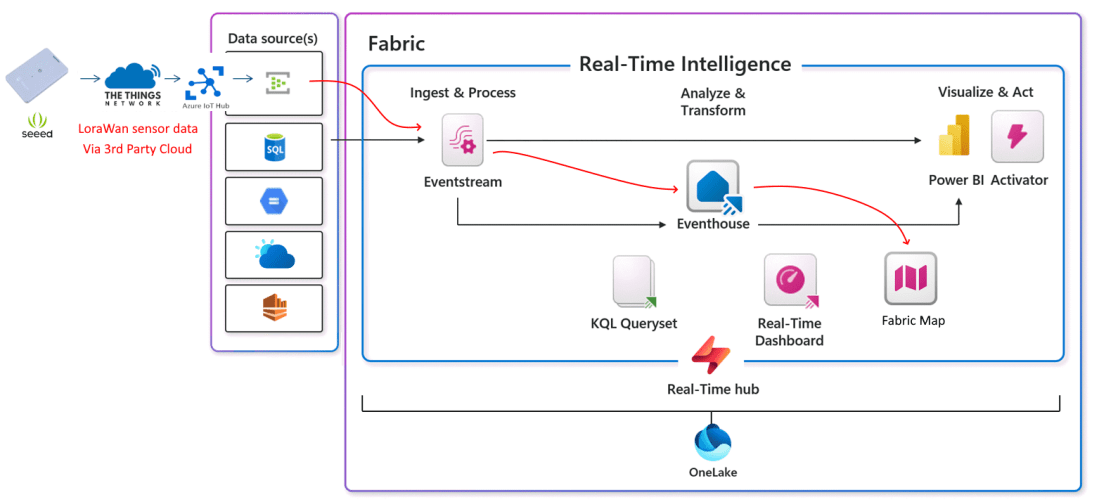
For the last couple of years, I have written about various ways to work with Microsoft Fabric Real-Time Intelligence data, both about ingesting, enriching, and representing real-time data.

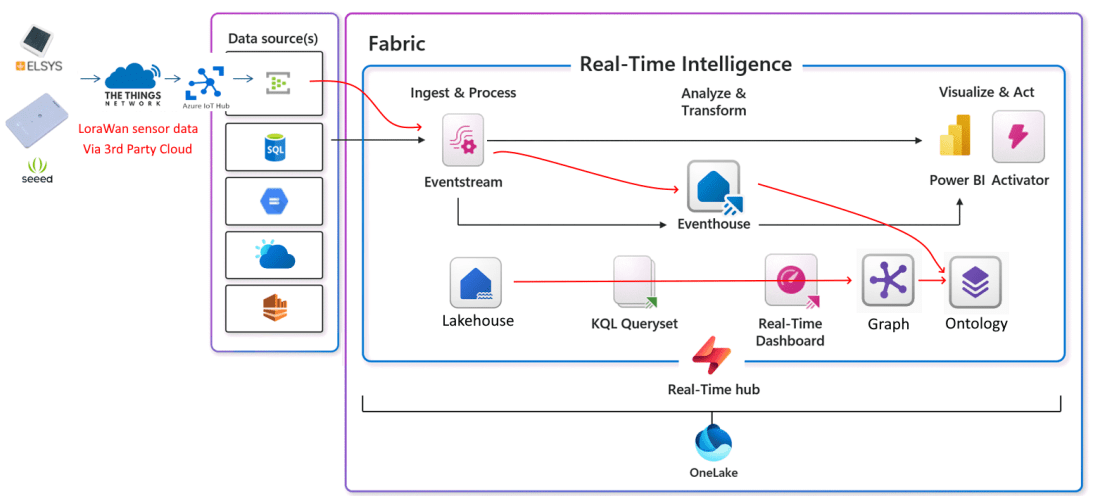
Adding Microsoft Fabric RTI to any IoT solution will add instant value because it’s another ‘head’ on top of IoT platforms, and it’s so easy to integrate.

It adds both Remote monitoring and Predictive maintenance capabilities based on real-time information flows, using telemetry and context data coming from IoT platforms and related enterprise systems. This is the easiest way to get real-time insights on an enterprise level.

Combining that real-time telemetry with slow-moving context data can be hard, though.

In the past, I used Azure Digital Twins together with Azure Data Explorer to cope with this challenge. A timeseries database shows us the historical time-series data in tables as ‘silos’. The digital twin environment gives us the modelled situation, the here and now, plus relationships. These two datastores complement each other.

Using Fabric Graph, we have learned how to model entities and relationships as nodes and edges. What if we could add real-time data to this?

Entering Fabric Ontology.

Let’s check out Fabric Ontology and see what is offered in this new Digital Twin experience within Microsoft Fabric.

Doorgaan met het lezen van “First look at Fabric Ontology”
First look at Microsoft Fabric Graph

For the last couple of years, I have written about various ways to work with Microsoft Fabric Real-Time Intelligence data, both about ingesting, enriching, and representing.

Adding Microsoft Fabric RTI to any IoT solution will add instant value because it’s another ‘head’ on top of IoT platforms, and it’s so easy to integrate.

It adds both Remote monitoring and Predictive maintenance capabilities based on real-time information flows, using telemetry and context data coming from IoT platforms and related enterprise systems.

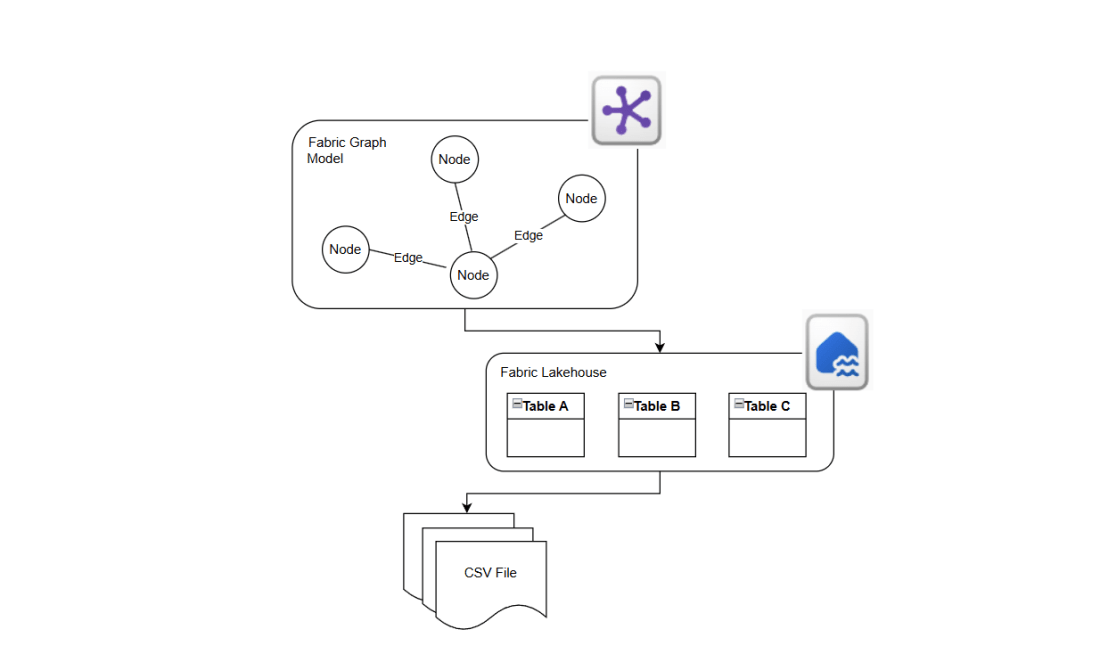
In the past, I have written about Azure Digital Twins. This is foremost a Graph database, containing twins (aka entities, nodes) and relationships (aka edges) between them. We can query graph databases to get insights about these entities as part of the graph.

Graphs are very useful for IoT solutions. Where a timeseries database shows us the historical recordings of telemetry (without any structural relationships), a graph database shows us the current here-and-now situation of the nodes in the graph, complete with relationships. Both types of databases complement each other. Combining both gives us full insight into your factory, even in a modelled way.

Via the graph database, we can navigate through the factory ontology, or Universal Namespace (UNS). Via the timeseries database, we can query the historical telemetry values of the ‘leaves’ of that relational ‘tree’.

Recently, Microsoft has introduced the Microsoft Fabric Graph database. Let’s check it out.

Doorgaan met het lezen van “First look at Microsoft Fabric Graph”

First look at Fabric Map on top of Fabric RTI

In the last couple of months, I have written about various ways to work with Microsoft Fabric Real-Time Intelligence data, both about ingesting, enriching, and representing.

Adding Microsoft Fabric RTI to any IoT solution will add instant value because it’s another ‘head’ on top of IoT platforms, and it’s so easy to integrate.

It adds both Remote monitoring and Predictive maintenance capabilities based on real-time information flows, using telemetry and context data coming from IoT platforms.

During the recent Fabric Conference 2025 in Vienna, Europe, this new Fabric Map was introduced.

This new way of visualizing geospatial data gives you a powerful visual (based on a kind of low-code data exploration) experience to work with data related to location-based data.

This is especially interesting for assets that are on the move.

It is in public preview now, so let’s check out what it offers currently.

Doorgaan met het lezen van “First look at Fabric Map on top of Fabric RTI”

Microsoft Fabric real-time analytics exploration: KQL Database mirroring

Microsoft Fabric is an all-in-one analytics solution for enterprises that covers everything from data movement to data science, Real-Time Analytics, and business intelligence.

For IoT Developers, this is a great addition to our Azure IoT resources toolkit because ingesting streams of IoT data is supported too.

In previous blog posts, we have seen how data can be streamed to eg. KQL databases or Lakehouses.

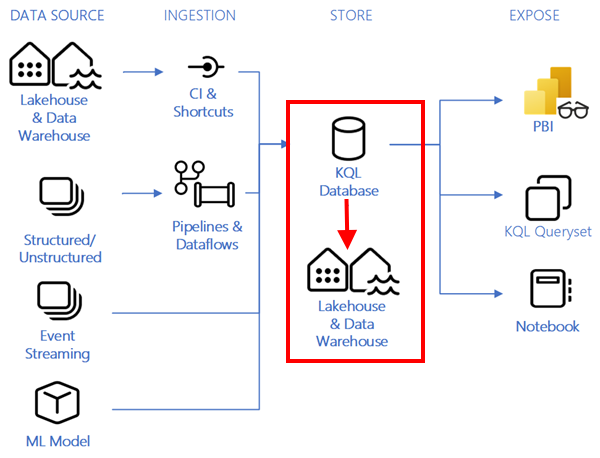
Today, we look at providing access to KQL database tables by mirroring the data via OneLake:

This way, already ingested data in a KQL Database is made available as one logical copy in OneLake.

Let’s see how this is done.

Doorgaan met het lezen van “Microsoft Fabric real-time analytics exploration: KQL Database mirroring”

Microsoft Fabric real-time analytics exploration: Streaming to a Lakehouse

Microsoft Fabric is an all-in-one analytics solution for enterprises that covers everything from data movement to data science, Real-Time Analytics, and business intelligence.

For IoT Developers, this is a great addition to our Azure IoT resource toolkit because streaming IoT data via IoT Hub integration is supported too.

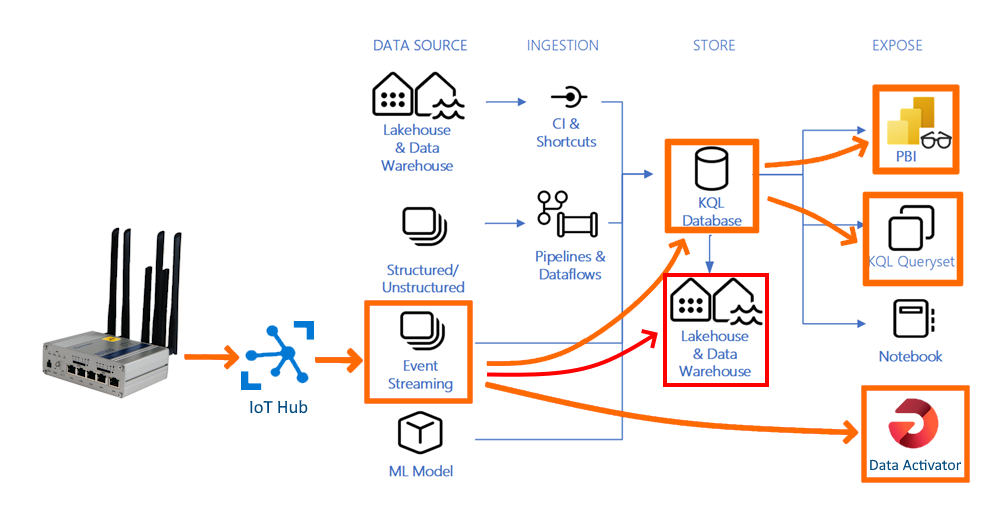
Next to warm (and potentially cold) path storage, Microsoft Fabric offers a solution to react to certain incoming data, the hot path.

In this post, we try to learn how data engineers could process and analyze our IoT data stream:

Today, we dive into the world of Microsoft Fabrick Lakehouses.

Doorgaan met het lezen van “Microsoft Fabric real-time analytics exploration: Streaming to a Lakehouse”